How to Calculate Aluminium Sulphate Dosage for Water Treatment
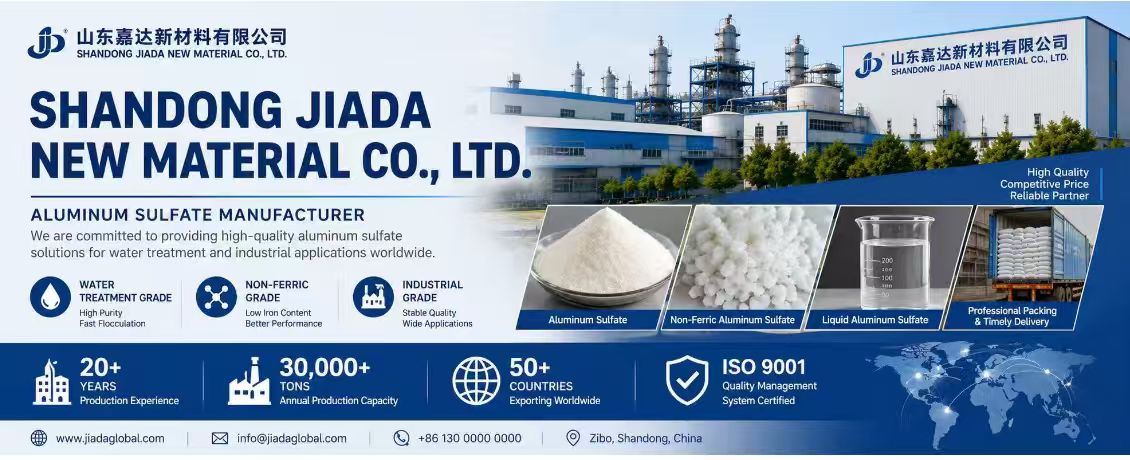
Aluminium Sulphate Dosage in Water Treatment Aluminium sulphate is widely used as a coagulant in water and wastewater treatment. One of the most important questions for treatment plants and engineering companies is: How much aluminium sulphate should be dosed? There is no single dosage that works for every water source. The appropriate dosage depends on factors such as: Raw water quality Turbidity Suspended solids Organic matter pH Alkalinity Temperature Treatment target Existing treatment process Therefore, aluminium sulphate dosage should ideally be determined through testing rather than simply applying a fixed number. Shandong Jiada New Material Co., Ltd. supplies aluminium sulphate for water treatment and industrial applications.
Why Aluminium Sulphate Dosage Matters If the dosage is too low, coagulation may be insufficient. This can result in: Poor floc formation Slow sedimentation Higher residual turbidity Reduced treatment efficiency If the dosage is too high, the treatment process may also become inefficient. Potential concerns include: Increased chemical consumption Higher treatment cost Changes in water chemistry Increased sludge generation Potential pH effects The objective is therefore not simply to use more aluminium sulphate. The objective is to find an effective dosage for the specific water conditions.
Basic Aluminium Sulphate Dosage Calculation A simple calculation can be used to estimate chemical consumption. If the required dosage is: D mg/L and the water flow is: Q m³/day then the approximate daily aluminium sulphate requirement is: Chemical consumption (kg/day) = D × Q ÷ 1000 For example: If the dosage is: 50 mg/L and the treatment flow is: 10,000 m³/day then: 50 × 10,000 ÷ 1000 = 500 kg/day So the estimated aluminium sulphate consumption is: 500 kg/day This is a calculation example only. The actual dosage must be determined according to the customer’s water quality and treatment process.
Example for a Larger Treatment Plant Suppose a wastewater treatment plant processes: 50,000 m³/day and laboratory testing indicates an aluminium sulphate dosage of: 80 mg/L The estimated daily consumption would be:
80 × 50,000 ÷ 1000
4,000 kg/day or: 4 metric tons/day Estimated monthly consumption at 30 days: 4 × 30 = 120 MT/month This type of calculation can help procurement teams estimate their monthly chemical requirements.
Why Jar Testing Is Important A dosage calculation tells you how much chemical would be consumed at a given dosage. It does not determine whether that dosage is optimal. For practical treatment optimization, a jar test is commonly used. A jar test can evaluate different dosages under controlled conditions. For example: 20 mg/L 30 mg/L 40 mg/L 50 mg/L 60 mg/L The treatment team can compare: Floc formation Sedimentation Final turbidity Water clarity pH changes The best dosage is then selected based on the treatment objective.
Raw Water Quality Can Change the Required Dosage The same treatment plant may not use exactly the same aluminium sulphate dosage throughout the year. Raw water characteristics can change due to: Rainfall Seasonal changes Industrial discharge Organic matter Suspended solids Turbidity changes For this reason, operators may need to adjust the dosage according to current water conditions.
pH and Alkalinity Matter Aluminium sulphate reacts with water and participates in coagulation processes. The effectiveness of coagulation can be affected by: pH and alkalinity. If the water chemistry is unsuitable, increasing the aluminium sulphate dosage may not solve the problem. The treatment team may need to evaluate: pH Alkalinity Coagulant dosage Mixing conditions Flocculation conditions Therefore, dosage optimization should consider the entire treatment process.
Dosage Is Different for Different Applications Aluminium sulphate dosage can vary significantly between applications. For example: Drinking Water Treatment The target may focus on: Turbidity reduction Suspended solids removal Organic matter reduction Water quality requirements Municipal Wastewater The objective may include: Phosphorus removal Suspended solids removal Enhanced clarification Industrial Wastewater The required dosage may depend strongly on the specific industrial wastewater characteristics. Examples include: Textile wastewater Paper mill wastewater Chemical wastewater Manufacturing wastewater Therefore, dosage should not be transferred directly from one application to another.
Powder, Granular and Other Physical Forms Aluminium sulphate can be supplied in different physical forms. Depending on the product: Powder can dissolve rapidly under suitable conditions. Granular products can provide convenient handling and dosing. Larger solid forms may require different dissolution or feeding procedures. The chemical dosage calculation is based on the required amount of product, while the actual feeding system should be adjusted according to the product’s physical form.
Converting Dosage into Monthly Procurement Procurement teams can use dosage calculations to estimate monthly demand. For example: Daily water treatment flow: 20,000 m³/day Dosage: 60 mg/L Daily consumption: 60 × 20,000 ÷ 1000 = 1,200 kg/day For 30 days: 1,200 × 30 = 36,000 kg Therefore: 36 MT/month This information can help the purchasing department plan: Monthly orders Safety stock Delivery schedules Storage capacity Annual contracts
How Dosage Affects Purchasing Cost Chemical purchasing cost depends not only on: Price per ton but also on: Actual dosage × water flow × operating days For example, a lower-cost product may not necessarily provide the lowest treatment cost if a higher dosage is required. A better comparison can consider: Treatment cost per m³ rather than only: Aluminium sulphate price per ton This is particularly important for large water treatment facilities.
What Information Should Buyers Provide to a Supplier? When discussing aluminium sulphate for water treatment, buyers can provide: Application Water treatment capacity Current dosage Water quality Required specification Physical form Monthly consumption Packaging Destination For example: We operate a wastewater treatment plant with a flow of 20,000 m³/day. Our current aluminium sulphate dosage is approximately 60 mg/L. Please provide your product specification and quotation. This gives the supplier useful information for understanding the application.
A Practical Dosage Optimization Process A practical process can be: Water Quality Analysis ↓ Select Candidate Coagulant ↓ Jar Test ↓ Compare Dosages ↓ Evaluate Flocculation and Sedimentation ↓ Confirm Operating Dosage ↓ Calculate Chemical Consumption ↓ Calculate Monthly Procurement ↓ Monitor and Adjust This process is generally more reliable than choosing a dosage based only on a general industry number.
Aluminium Sulphate Dosage Calculation Formula For quick reference: Daily Consumption kg/day = Dosage (mg/L) × Flow (m³/day) ÷ 1000 Monthly Consumption MT/month = Dosage (mg/L) × Flow (m³/day) × Operating Days ÷ 1,000,000 For example:
60 mg/L × 20,000 m³/day × 30 days ÷ 1,000,000
36 MT/month
Shandong Jiada Aluminium Sulphate for Water Treatment Shandong Jiada New Material Co., Ltd. supplies aluminium sulphate for water treatment and industrial applications. Customers can discuss: Product specification Aluminium sulphate physical form Packaging Sample requirements COA TDS SDS Bulk supply Export packaging FOB/CFR/CIF quotations For water treatment projects, customers should evaluate the product together with their specific water quality and treatment process.
Conclusion There is no universal aluminium sulphate dosage for every water treatment application. The required dosage depends on: Water quality + pH + alkalinity + turbidity + suspended solids + treatment objective + process conditions A basic consumption calculation can be made using: kg/day = Dosage (mg/L) × Flow (m³/day) ÷ 1000 However, calculation alone does not determine the optimum treatment dosage. For practical applications, jar testing and process evaluation can help identify an appropriate operating dosage. For procurement planning, the selected dosage can then be converted into: Daily Consumption → Monthly Consumption → Annual Requirement This helps water treatment plants and industrial users make more accurate purchasing plans.