Aluminium Sulphate for Water Purification: How Coagulation Helps Improve Water Quality
Understanding Aluminium Sulphate in Water Purification
Clean and reliable water is essential for communities, industries, and environmental management.
Water sources may contain suspended particles, clay, natural organic matter, and other impurities that cannot always be removed effectively through simple filtration.
Coagulation is therefore an important stage in many conventional water purification systems.
Aluminium sulphate is a widely used inorganic coagulant that can help destabilize fine particles and promote floc formation, making impurities easier to separate from water.
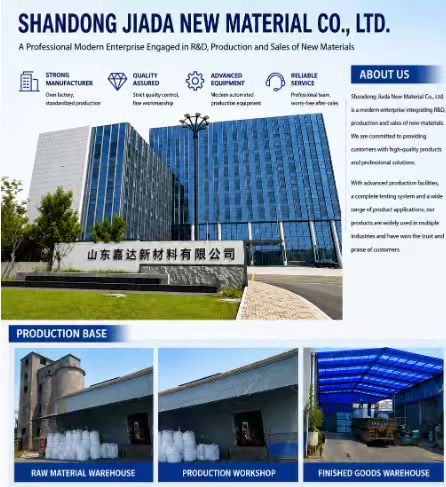
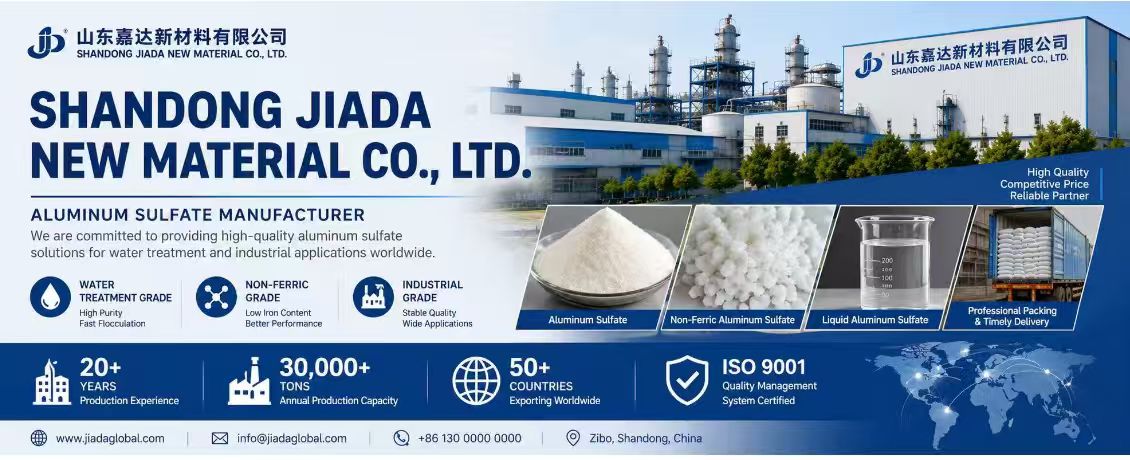
Shandong Jiada New Material Co., Ltd. is a professional aluminium sulphate manufacturer in China, supplying aluminium sulphate for water purification, wastewater treatment, and industrial applications.
What Is Water Purification?
Water purification involves a series of processes designed to improve water quality.
Depending on the water source and treatment objectives, a treatment system may include:
Coagulation Flocculation Sedimentation Filtration Disinfection Additional treatment processes
The exact process depends on the characteristics of the source water.
Why Is Coagulation Important?
Very small particles can remain suspended in water for long periods.
These particles may include:
Clay Silt Fine organic matter Colloidal particles
Because many of these particles are difficult to settle naturally, a coagulant can be introduced to help destabilize them.
This allows smaller particles to combine into larger aggregates.
How Aluminium Sulphate Supports Water Purification 1. Particle Destabilization
Many fine particles in water have surface charges that prevent them from naturally joining together.
When aluminium sulphate is introduced under suitable conditions, it can help destabilize these particles.
- Floc Formation
After destabilization, particles can combine to form larger flocs.
These flocs can capture additional suspended matter and other impurities.
- Sedimentation
Larger flocs generally settle more easily than individual fine particles.
Water treatment systems can then use sedimentation tanks to separate the flocs from the treated water.
- Filtration
After sedimentation, filtration can provide an additional treatment stage.
Common filtration systems include:
Sand filtration Multimedia filtration Other engineered filtration technologies
The combination of coagulation, flocculation, sedimentation, and filtration can significantly improve water clarification.
Applications of Aluminium Sulphate in Water Purification
Aluminium sulphate can be used in various water treatment applications.
Municipal Water Treatment
Municipal water treatment plants may use aluminium sulphate during conventional clarification processes.
Industrial Water Treatment
Factories may use coagulation chemicals to treat process water or improve water quality before subsequent treatment stages.
Surface Water Treatment
Surface water from rivers, reservoirs, and lakes can contain significant levels of suspended particles and natural organic matter.
Coagulation can help improve clarification.
Factors Affecting Treatment Performance
The effectiveness of aluminium sulphate depends on actual water conditions.
Important factors include:
Raw Water Quality
Different water sources contain different levels of:
Turbidity Suspended solids Organic matter Mineral substances pH
pH has an important influence on coagulation chemistry.
Dosage
The required aluminium sulphate dosage varies according to water characteristics and treatment objectives.
Mixing
Rapid mixing and subsequent flocculation conditions influence the formation of effective flocs.
Temperature
Water temperature can affect reaction and settling behavior.
Why Jar Testing Is Important
There is no single aluminium sulphate dosage that is suitable for every water source.
Water treatment operators can use laboratory jar testing to evaluate different treatment conditions.
A jar test may compare:
Different aluminium sulphate dosages Different pH conditions Floc formation Settling performance Turbidity reduction
The results can then be used to develop an appropriate operating strategy.
Choosing Aluminium Sulphate for Water Purification
When purchasing aluminium sulphate, water treatment companies should consider:
Product Specifications
Important parameters may include:
Aluminium oxide content Iron content Insoluble matter Moisture Physical form Supply Stability
Large water treatment facilities require continuous chemical supply.
Packaging
Common packaging options include:
25kg bags 500kg bags 1000kg jumbo bags Technical Documentation
International buyers may request:
COA TDS SDS Product specifications Why Choose Shandong Jiada?
Shandong Jiada New Material Co., Ltd. focuses on the manufacturing and supply of aluminium sulphate for global customers.
The company provides:
✅ Stable aluminium sulphate products ✅ Large-scale supply capability ✅ Professional quality control ✅ Export packaging solutions ✅ International logistics support
The products can be supplied for customers involved in:
Water purification Wastewater treatment Municipal water projects Industrial water treatment Chemical distribution Conclusion
Aluminium sulphate remains an important coagulant for many conventional water purification systems.
By supporting particle destabilization and floc formation, it can help improve clarification and subsequent sedimentation and filtration processes.
The appropriate product specification and dosage should always be selected according to actual water quality, treatment objectives, and process conditions.
For international buyers looking for an aluminium sulphate manufacturer in China, Shandong Jiada New Material Co., Ltd. provides professional manufacturing and global supply solutions.